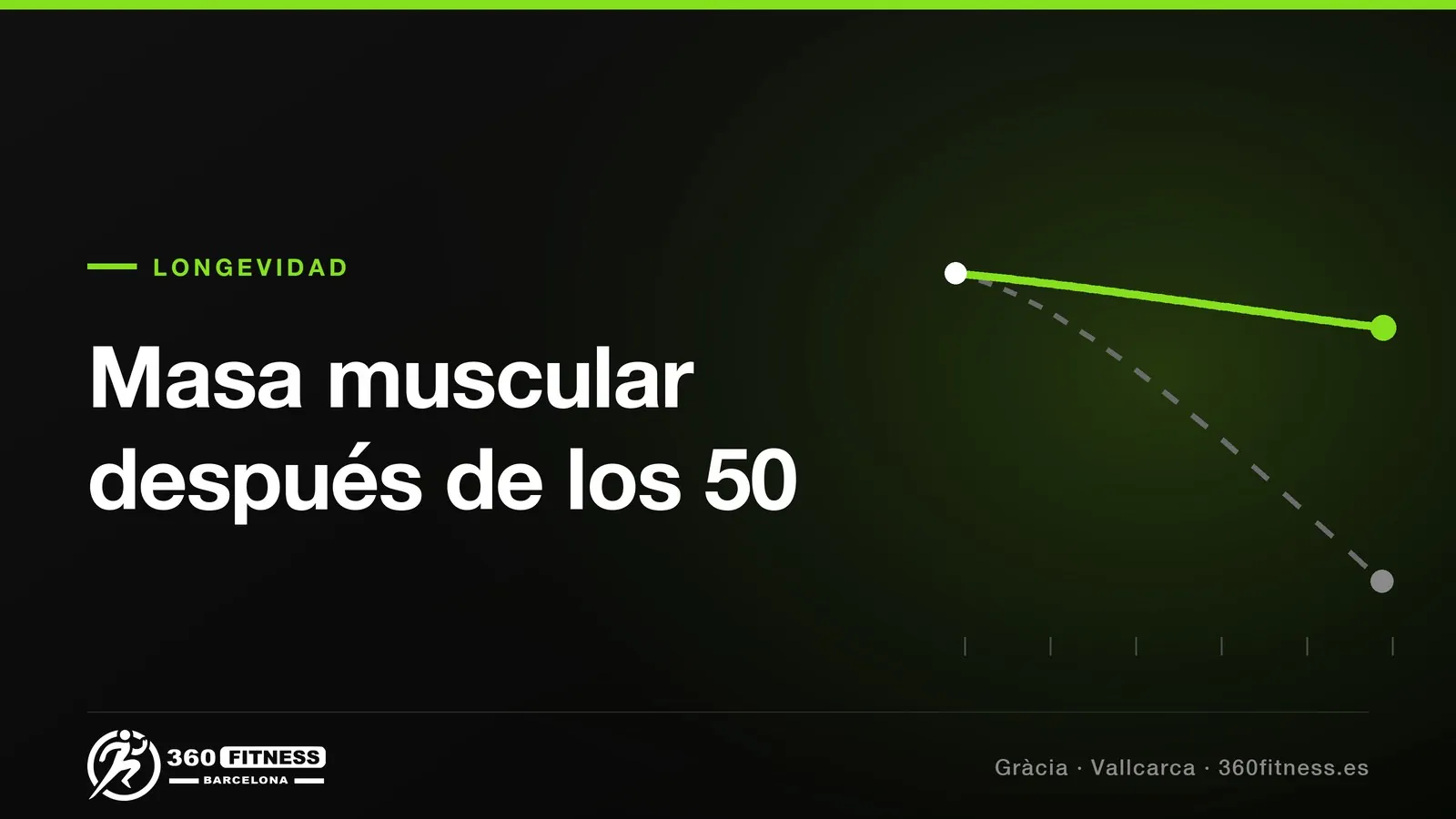
From our thirties we start losing muscle mass silently, and from our fifties the process speeds up. You do not notice it all at once: you notice it the day it is hard to get up from a low chair, the suitcase weighs more than you remembered, or walking up the hill to your home leaves you out of breath.
That process is called sarcopenia. And the important thing is not that it exists, but that it responds very well to the right stimulus, even when you start in your sixties or seventies.
What exactly is lost
The usual estimates speak of a loss of between 3 % and 8 % of muscle mass per decade from the thirties onwards, with a clear acceleration after sixty. But mass is only part of the problem: strength is lost two to three times faster than mass, and power (the ability to generate force quickly) faster still.
This explains a common situation: people who apparently keep their muscle volume but can no longer react to a stumble. Power is the first thing to go and the thing that protects most against falls.
Why it matters beyond appearance
· Independence. Getting up from the floor, climbing stairs or carrying the shopping depend directly on lower-body strength.
· Falls and fractures. More strength and better balance reduce the risk of falling, which is one of the main determinants of loss of independence from a certain age.
· Metabolism and glucose. Muscle is the main destination of the glucose circulating in your blood. Less muscle means poorer handling of sugar.
· Bone. Mechanical load is one of the few stimuli that increase bone density. Walking is not enough: load is needed.
· Functional reserve. If one day you fall ill and spend two weeks in bed, the amount of muscle you started with determines how you come out of it.
Anabolic resistance: why you need more now
With age a phenomenon called anabolic resistance appears: the same amount of protein and the same training stimulus produce a smaller response than at twenty-five. It does not mean it does not work; it means the dose has to go up.
In practice this translates into two adjustments:
· More protein. The recommended range rises to 1.2 to 1.6 g per kilo of body weight, and up to 2.0 g/kg if you do strength training with the aim of gaining mass. And above all, spread out: 25 to 40 grams at each main meal, because the threshold for activating synthesis is higher than before. We go into detail in our guide on how much protein you need per day.
· A higher-intensity stimulus. Very light loads are not enough. You have to reach a real effort, with progression.
Strength is the main stimulus (and it is not dangerous)
There is an idea that lifting weights from a certain age is risky. The evidence points in exactly the opposite direction: supervised strength training is one of the safest interventions, with one of the best benefit-to-risk ratios, in older people. What is truly risky is the progressive loss of strength.
What does change compared with a thirty-year-old is the approach:
| Variable | How to approach it |
|---|---|
| Frequency | 2 to 3 strength sessions a week |
| Intensity | Moderate to high, leaving 2 to 3 repetitions in reserve |
| Repetitions | 6 to 12 in most exercises |
| Progression | Slower but steady; prioritise adding weeks, not records |
| Power | Fast concentric phase in safe exercises (leg press, step-up) |
| Balance | Unilateral work and controlled unstable supports |
| Warm-up | Longer than at 25; connective tissue needs more time |
Speed matters
A nuance that is often overlooked: as well as strength, you have to train power. Not with maximum loads, but with the intention of moving fast in the pushing phase. Getting up quickly from a chair, stepping up decisively or pushing fast on the leg press train exactly the quality that prevents a fall.
The particular case of menopause
The fall in oestrogen accelerates the loss of both lean mass and bone density, and usually coincides with changes in fat distribution. It is a time when strength training goes from advisable to a priority. We wrote about it in our article on menopause and fitness.
Which supplements have real backing
The foundation is always food and training. That said, there are three with reasonable evidence in this age group:
· Creatine monohydrate. One of the most studied supplements. In older people, combined with strength training, it is associated with improvements in lean mass and strength. We have an article devoted to creatine.
· Vitamin D. Deficiency is common and is related to muscle function and bone health. It is worth measuring it in a blood test before supplementing blindly.
· Protein powder. It is not essential, but it solves the practical problem of reaching the daily amount when appetite drops, which is common with age.
If you take long-term medication or have a diagnosed kidney, cardiovascular or bone condition, consult your doctor before introducing supplements or starting an intense strength programme. General recommendations do not replace an individual assessment.
Recovery: the other 50 %
With age, the capacity to recover between sessions decreases. Training more does not make up for recovering worse. Three levers:
· Sleep. This is where most tissue repair takes place.
· Real rest days between strength sessions on the same muscle groups.
· Active recovery. Walking, mobility and low-intensity work on the days in between.
At our centre we complement this with Recovery 360 sessions, which combine massage, PEMF therapy and red light in a single session. You can read how it works here.
What to expect if you start now
Studies of older people who start strength training show significant improvements in strength in the first 8 to 12 weeks, even in people of advanced age with little previous experience. Changes in muscle mass come somewhat later and are more modest than at thirty, but they come.
What matters most almost never shows on the scales: it is getting up without holding on, walking up the hill without stopping and going down stairs with confidence.
Frequently asked questions
Can you gain muscle at 60 or 70?
Yes. The response is smaller than at twenty, but it is well documented at any age provided there is enough stimulus and adequate protein.
Is it better to walk or to lift weights?
Walking is excellent for cardiovascular health, but it does not slow sarcopenia. To keep muscle and bone, load is needed. Ideally, do both.
What if I have osteoarthritis?
Well-dosed strength training is one of the usual recommendations for osteoarthritis of the knee and hip, because a strong muscle takes load off the joint. It calls for individual adaptation, not avoidance.
How long until I notice something?
Strength and stability, between 4 and 8 weeks. Changes in body composition, from the third month.
Start with an objective assessment
Book a free trial session with advanced body analysis: muscle mass, fat, water and metabolism, more than 60 metrics. It is the way to know where you stand and to really measure whether the plan is working.
We train in groups of six people at most with a certified trainer, which is what makes it possible to adapt each exercise to what your body tolerates today.
360Fitness Barcelona · Carrer d'Esteve Terradas 33, 08023 Barcelona (Vallcarca) · Phone and WhatsApp: +34 663 90 30 31 · 360fitness.bcn@gmail.com