Group training in Barcelona: why small groups often give better results than training alone
Published · 3 min read
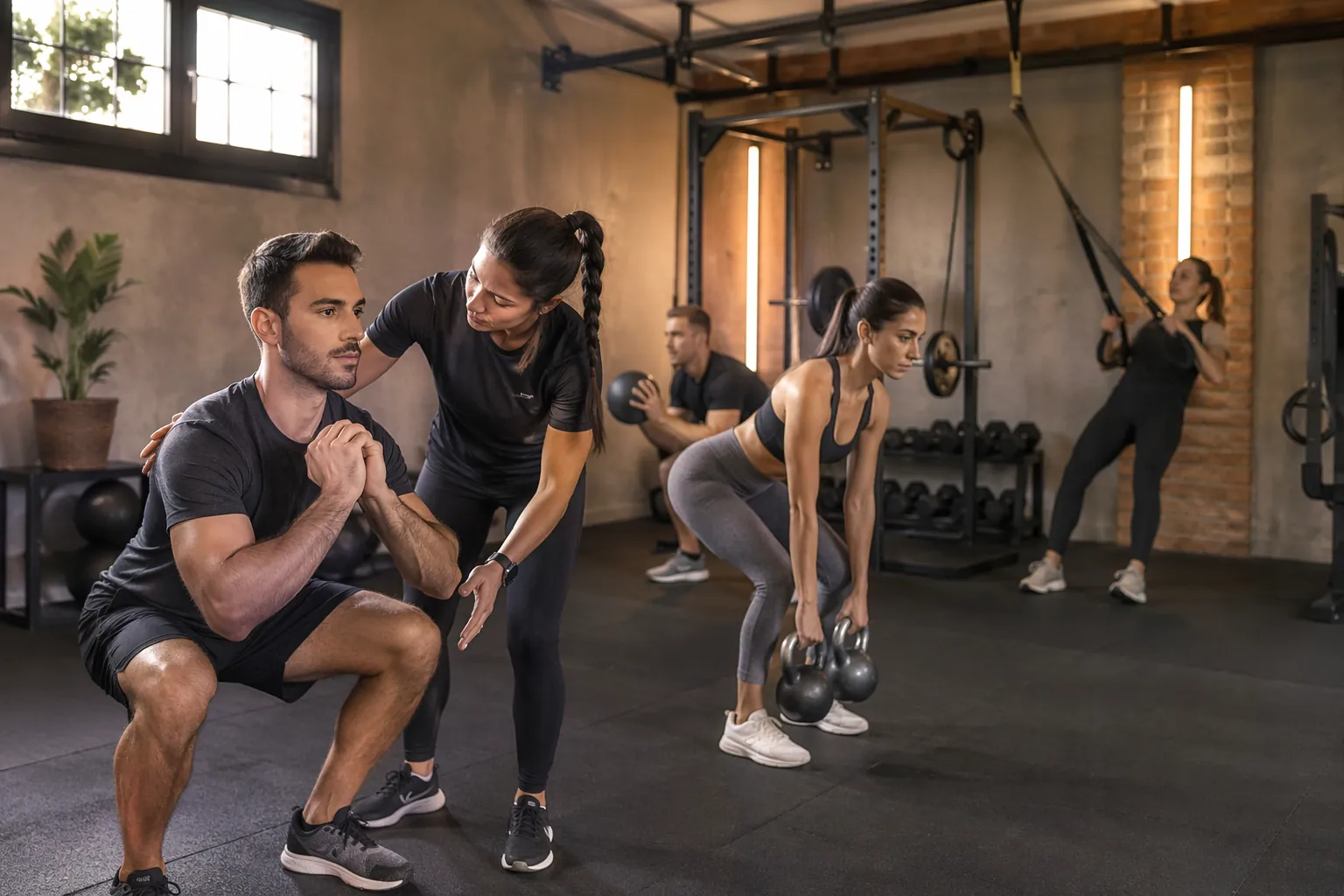
If you are looking for a way to train in Barcelona that is effective, sustainable and less impersonal than an overcrowded gym, small-group training deserves far more attention than it usually gets. It is not simply “doing a class with more people”. Done properly, it is a formula that combines structure, follow-up, motivation and a gentler way in for anyone who truly wants to improve without relying on willpower alone.
Many people try a traditional gym first. They pay the fee, go for several days feeling motivated, use a few machines, look up routines on their phone and after a few weeks they stall. It does not always happen for lack of discipline. Often the problem is simpler: training without a clear structure demands experience, self-management and consistency. That is exactly where well-coached group training makes the difference.
What a small group gives you that training on your own does not
The first advantage is adherence. When you train at a set time and in a setting where a coach is watching over the session, it is much easier to show up, complete the work and come back the following week. Consistency depends less on “feeling like it” than on having a routine that is easy to sustain.
The second advantage is technique. In a small group, the coach can correct a squat, adjust a load or adapt an exercise if you arrive with aches, something that rarely happens when you train alone and even less in a full gym. That continuous correction does not only improve results; it also reduces mistakes that later slow progress or end in pain.
The third is pace. Many people, when they train alone, fall short or lose focus. They rest too long, switch exercises with no logic or do not know how to progress. In a coached group, the session is already designed: you know what is on the plan, how long it lasts and what its goal is. That structure removes a lot of friction.
Who it works especially well for
Group training in Barcelona tends to work very well for four profiles. First, people who have wanted to get in shape for a long time but cannot manage to keep up a routine. Second, those who value real attention without always paying the cost of one-to-one personal training. Third, people who need clear progression in strength, mobility or endurance, but do not know how to programme it by themselves. And fourth, those who feel uncomfortable in very large or overly impersonal gyms.
It also fits very well with tight schedules. When a session is organised, starts at a set time and lasts just as long as it needs to, it is easier to fit into the working week. By contrast, when the plan is “I'll go to the gym when I can”, training tends to lose priority.
Common mistakes when choosing a group
Not all groups work the same way. A frequent mistake is to think that any group class will do. A mass class with barely any correction is not the same as a compact group where the coach knows the people, their limitations and their goals.
Another mistake is to look only at intensity. Many people associate “a good workout” with finishing exhausted, but intensity without control does not always equal progress. A good group does not just make you sweat; it helps you improve technique, strength, cardiovascular capacity and consistency week after week.
It is also worth looking at the real size of the group, the kind of follow-up and whether the offer is designed for mixed profiles or only for people who are already advanced. A well-designed small group should allow for adaptation, not force you to always go to the limit.
What results you can realistically expect
When a person suits this format, the usual first thing to notice is an improvement in consistency. Then come more visible changes: better posture, more energy, better tolerance of effort, more strength and a greater sense of control over your own body. If your diet supports it too, it is much easier to improve body composition.
You do not need to train every day. In fact, for many people, two or three well-done sessions a week in a small group work better than five chaotic workouts with no progression.
When it is a better deal than personal training
Personal training is still the best option when you need the highest level of individualisation, are coming back from a complex injury or are pursuing a very specific goal. But for many people, the small group offers a better balance between attention, energy and cost. You get correction, structure and support without giving up the social component that often makes the habit easier to keep.
Conclusion
If you are weighing up options for training in Barcelona, do not think of group training as a “lesser” version of personal training. When the group is compact and well coached, it can be one of the smartest ways to start, restart or consolidate a routine. The key is not to train in the most spectacular way, but in the way you can sustain and that really makes you progress.